
Not all dentists do the same job. If you’ve ever needed a crown, an implant, or a full set of dentures, you may have been referred to a specialist instead of staying with your regular dentist. That specialist is usually a board-certified prosthodontist.
Understanding the difference between a general dentist and a prosthodontist can help you get the right care faster. It can also save you from repeated treatments that don’t hold up over time.
This article breaks down exactly how these two types of dental professionals differ, and when you should choose one over the other.
The Core Difference: Maintenance vs. Reconstruction
General dentists are your primary care providers for oral health. They handle checkups, cleanings, fillings, and early-stage problems.
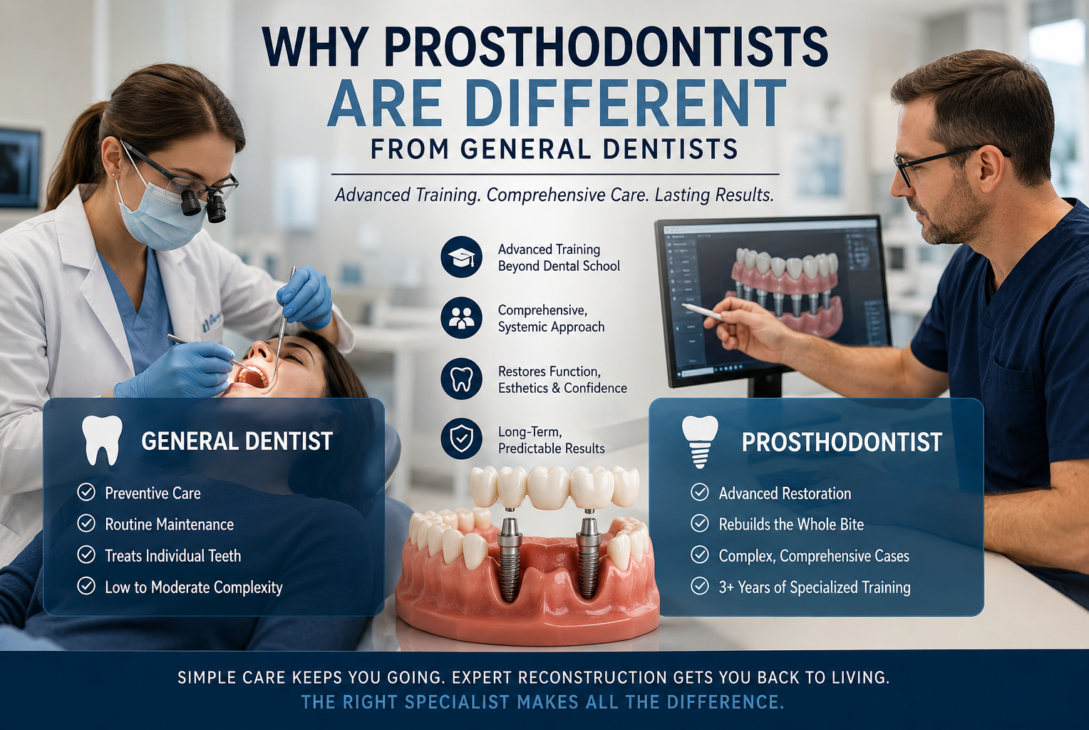
A prosthodontist takes over when the job gets more complex. Rather than isolated repairs, a prosthodontist focuses on rebuilding and replacing teeth as part of a complete, functioning bite.
Think of it this way: a general dentist keeps your mouth healthy day to day. A prosthodontist rebuilds it when something has gone seriously wrong, or replaces what’s missing entirely.
Same Starting Point, Very Different Training
Both professionals begin the same way. They earn a dental degree, either a DDS or a DMD, after finishing dental school.
From there, the paths split. A general dentist can begin practicing right away. A prosthodontist goes on to complete three additional years of residency training accredited by the Commission on Dental Accreditation (CODA), the national body that oversees dental education standards.
That residency involves roughly 3,000 to 4,500 hours of focused clinical training. During this time, prosthodontists study how the jaw joint, facial muscles, and teeth work together as one system, along with advanced materials science used in crowns, bridges, dentures, and implants.
Many prosthodontists go a step further and pursue board certification through the American Board of Prosthodontics, which requires passing a series of rigorous written and oral exams. This is what distinguishes a board certified prosthodontist from a general practitioner who occasionally performs restorative work.
Side-by-Side Comparison
| Feature | General Dentist | Prosthodontist |
|---|---|---|
| Primary Role | Preventive care and routine maintenance | Advanced restoration and tooth replacement |
| Post-Dental School Training | Not required to practice | 3 years of CODA-accredited residency |
| Approach to Care | Focuses on individual teeth | Treats the mouth as one bite system |
| Case Complexity | Low to moderate | Highly complex, often multi-disciplinary |
| Team Role | Refers complex cases out | Often leads a multi-specialist treatment team |
Key Differences in Scope of Practice
Systemic Thinking vs. Isolated Repairs
A general dentist typically treats each tooth as its own problem to solve. A cavity gets filled. A chip gets smoothed.
A prosthodontist vs general dentist comparison really comes down to this: prosthodontists look at the whole picture. Before placing even a single crown, they calculate how it will affect chewing pressure, wear patterns, and alignment across your entire bite.
This systemic approach is why prosthodontists are often called in for cases where several teeth, or an entire arch, need attention at once.
Reconstructive and Restorative Focus
General dentists handle the everyday essentials: cleanings, cavities, and simple extractions. When damage goes beyond that scope, prosthodontists step in.
They are trained specifically as a full mouth reconstruction specialist, managing major tooth loss, chronic TMJ disorders, and complete smile rebuilds after years of decay or wear.
Maxillofacial and Trauma Care
Prosthodontists also fill a role most people never think about until they need it. They design custom oral prostheses for patients recovering from oral cancer, facial trauma, or congenital conditions affecting the mouth and jaw.
This kind of specialized, reconstructive work sits well outside the typical general dentistry practice, which is one reason prosthodontics is recognized as its own dental specialty.
When to Choose a Prosthodontist Over a General Dentist
Not every dental issue calls for a specialist. But certain situations are better handled by someone with advanced restorative training. Consider seeking out complex dental restoration in Boca Raton from a prosthodontist if you’re dealing with:
- Multiple missing teeth requiring partial or complete dentures
- Full-arch dental implant placement and restoration
- Full-mouth reconstruction due to severe decay, acid erosion, or trauma
- Crowns or bridges that keep failing or breaking
- Chronic TMJ pain or jaw disorders affecting your bite
If any of these sound familiar, a consultation with a specialist is likely to save you time, money, and repeat procedures down the road.

Why This Matters for Your Smile
Choosing the right provider isn’t just about credentials. It’s about matching the complexity of your case to the right level of expertise.
A simple filling doesn’t need a specialist. But a full prosthodontics smile makeover involving implants, bite correction, or extensive rebuilding does. Trusting that kind of work to someone with the right training helps ensure it’s done correctly the first time, so you’re not back in the chair repeating treatment within a year or two.
This is exactly the kind of care Dr. Derek Gatta, DMD, provides at Innovative Dental Aesthetics in Boca Raton, where advanced restorative and reconstructive cases are treated with the depth of training they require.
Ready for a Second Opinion?
If you’ve been told you need extensive dental work, or if previous restorations haven’t held up, it may be worth talking to a prosthodontist before moving forward. A specialist can evaluate your full bite, not just the tooth in front of you, and build a plan that lasts.