
One missing tooth can lead to problems far more complicated than a less radiant smile. It can affect your chewing, speaking, and even your confidence in smiling at and talking with others. The positive aspect is that current dental options provide dependable results that act, feel, and look like your normal teeth.
If you are having trouble deciding whether a single tooth replacement or treatment of multiple missing teeth is the right solution for you, you are not alone. This is one of the more typical questions individuals ask when losing one or more teeth. Both options aim to restore your smile, but it ultimately comes down to your oral health, the number of teeth you have lost, your long-term goals, and your budget.
All right, let’s break everything down into simpler terms!
Understanding How Dental Implants Work
Instead of just replacing the visible part of a missing tooth, dental implants replace the root and most of the structure of a tooth.
During the healing process, a small titanium post is inserted into the jawbone, where it will gradually bond with the bone. After the implant has stabilized, it anchors a personalized replacement that integrates seamlessly with your other teeth.
Such an all-on-4 implant restoration has numerous advantages when compared with traditional bridges or removable dentures. It provides superior stability, helps preserve the density of the jawbone, restores natural chewing ability, and creates a smile that looks strikingly realistic.
Since implants work like the roots of natural teeth, they support the face over time by preventing bone loss in the spaces left by missing teeth.
When Replacing One Tooth Is the Best Choice
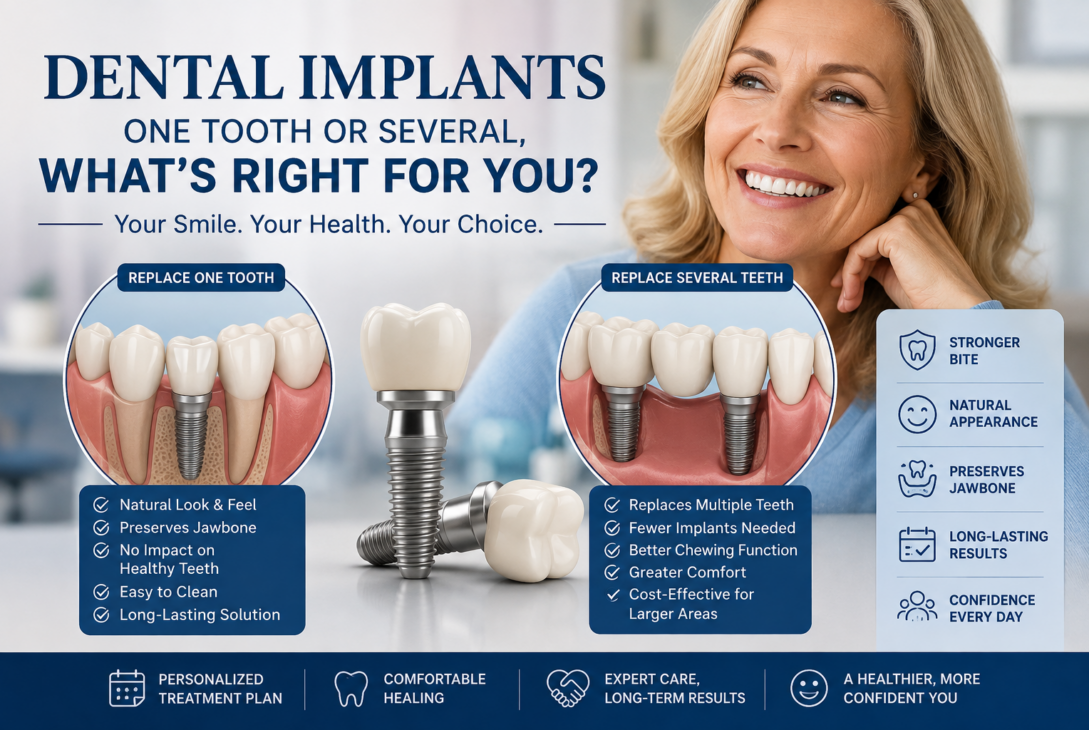
If you’ve only lost one tooth and you have healthy surrounding teeth, replacing your lost tooth with its own implant is usually the most conservative option.
Unlike traditional bridges, healthy neighboring teeth do not require reshaping to provide support. Because each implant is independent, treatment does not affect neighboring teeth.
Many patients do this because it includes:
- Natural look that integrates with adjacent teeth
- Strong chewing performance.
- Easy brushing and flossing.
- Long-term jawbone preservation.
- Excellent durability with proper care.
Typically, your treatment will consist of a consultation, implant placement, a healing period for the bone to combine with the implant, and then attaching the customized crown.
The healing process takes time, but the outcome often feels almost like having a tooth again.
When Several Teeth Need Replacement
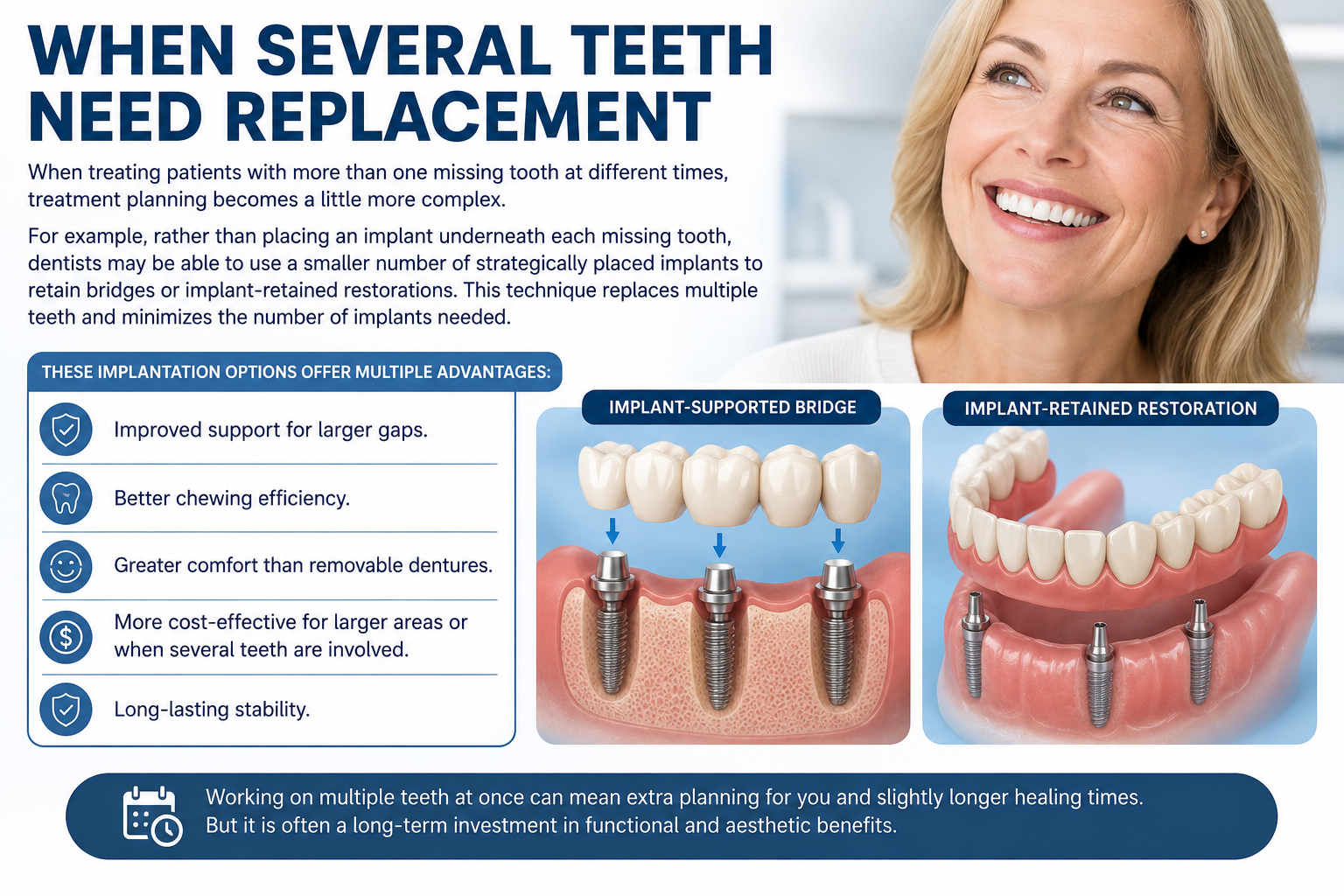
When treating patients with more than one missing tooth at different times, treatment planning becomes a little more complex.
For example, rather than placing an implant underneath each missing tooth, dentists may be able to use a smaller number of strategically placed implants to retain bridges or implant-retained restorations. This technique replaces multiple teeth and minimizes the number of implants needed.
These implantation options offer multiple advantages:
- Improved support for larger gaps.
- Better chewing efficiency.
- Greater comfort than removable dentures.
- More cost-effective for larger areas or when several teeth are involved.
- Long-lasting stability.
Working on multiple teeth at once can mean extra planning for you and slightly longer healing times. But it is often a long-term investment in functional and aesthetic benefits.
Comparing Treatment Time and Recovery
It is common for patients to ask how long the process is.
The time it takes for full recovery will vary, depending on several factors such as bone quality, healing capability, and whether other procedures may need to be carried out, such as bone grafting.
As you have fewer surgical sites to heal from, aftercare is also less invasive, which makes the experience generally more expedited and comfortable when replacing one tooth.
Multiple implant therapies may require longer healing periods, since larger portions of the mouth are involved. However, most patients generally find that any pain is controlled with standard postoperative care and prescribed medications from their dentist.
However, healing takes time and must be encouraged, as the implant will need to integrate properly with the jawbone to succeed.
Cost Considerations
A dental implant treatment should be considered an investment rather than an immediate expense.
The cost of replacing one missing tooth naturally is lower than that of restoring several teeth. Although several teeth need replacement, as several teeth are supported by fewer implants, the average price per restored tooth decreases.
Another factor you should take into consideration is time value.
Because implants provide a real, permanent solution and protect surrounding teeth and bone, they will minimize the need for future restorative treatments. Over time, most patients believe the improved function, appearance, and confidence are worth the price.
Feel free to ask your dentist to explain the treatment plan, as well as payment options, as prescribed by your individual needs.
Elements Impacting Treatment Selection
Selecting a dental surgeon based on the number of missing teeth alone is incorrect when it comes to choosing between implant treatments.
Before giving you recommendations, your dentist will evaluate several factors such as:
- Overall oral health.
- Jawbone density.
- Gum health.
- Bite alignment.
- Location of missing teeth.
- Lifestyle habits.
- Long-term expectations.
Restoration function is as important as natural appearance, and an individualized treatment plan facilitates proper function throughout the life of the restoration.
The reason for our professional evaluation is that no two smiles are the same.
Life After Implant Treatment
Perhaps one of the most significant factors in why patients opt for implants is how natural they feel after the healing process has returned to normal.
Everyone else is back to eating whatever they like, smirking like a supermodel, and talking a mile a minute.
Daily care is also delightfully easy.
Maintaining good oral hygiene includes:
- Brushing twice daily.
- Flossing carefully around restorations.
- Attending regular dental checkups.
- Preventing tooth-breaking habits like chewing hard objects.
When properly maintained, implant-borne restorations can function reliably for decades.
Frequently Asked Questions
Are dental implants permanent?
They are made to last a lifetime, as they are a permanent solution. Although the restoration on the implant may require replacement over time due to routine wear, an implant can last many years if properly cared for.
Does implant placement hurt?
Local anesthesia is used to perform the procedure, which makes treatment comfortable for most patients. Discomfort post-procedure is normal but treated effectively with conventional analgesics.
Can implants replace several missing teeth?
Yes. Implant options can replace multiple teeth with fewer implants placed in areas where they offer the most significant benefit, allowing dentists to place bridges or larger restorations.
Who is not eligible for Dental Implants?
Dental implants are often a possibility for most healthy adults who have ample jawbone density and healthy gums. The best course of treatment can only be determined after a comprehensive dental examination.
Making a Small Investment in a Stronger, Healthier Smile
While improving appearance is a big part of replacing missing teeth, there’s way more than that. It restores proper function, supports long-term oral health, and allows you to smile, eat, and speak confidently without worrying about what others think.
Implant dentistry is so advanced today that if we are replacing one tooth or multiple teeth, we can achieve predictable, natural-looking results that will impact the quality of your life. You’ll be able to choose the treatment that best supports your smile for years to come by discussing your goals, oral health, and expectations with your dental professional.