
Toothache has a funny little way of knocking on the door of your day and never giving up until you have opened the door. Initially, it seems to be an inconvenient nuisance, something you can put up with or alleviate with some painkillers. When that feeling does not go away or even gets worse, your body is sending you a message that there is more to it. So, in most instances, that “simple tooth-ache” may well be a warning that you need root canal surgery performed to prevent the tooth from being lost and, at last, cure the problem at the source.
These days, modern dentistry has made root canals a considerably more comfortable and predictable procedure. The key is to catch early warnings before the problem ever ripens into something bigger. Here are the five signs your tooth may be in trouble, and the importance of taking action early.
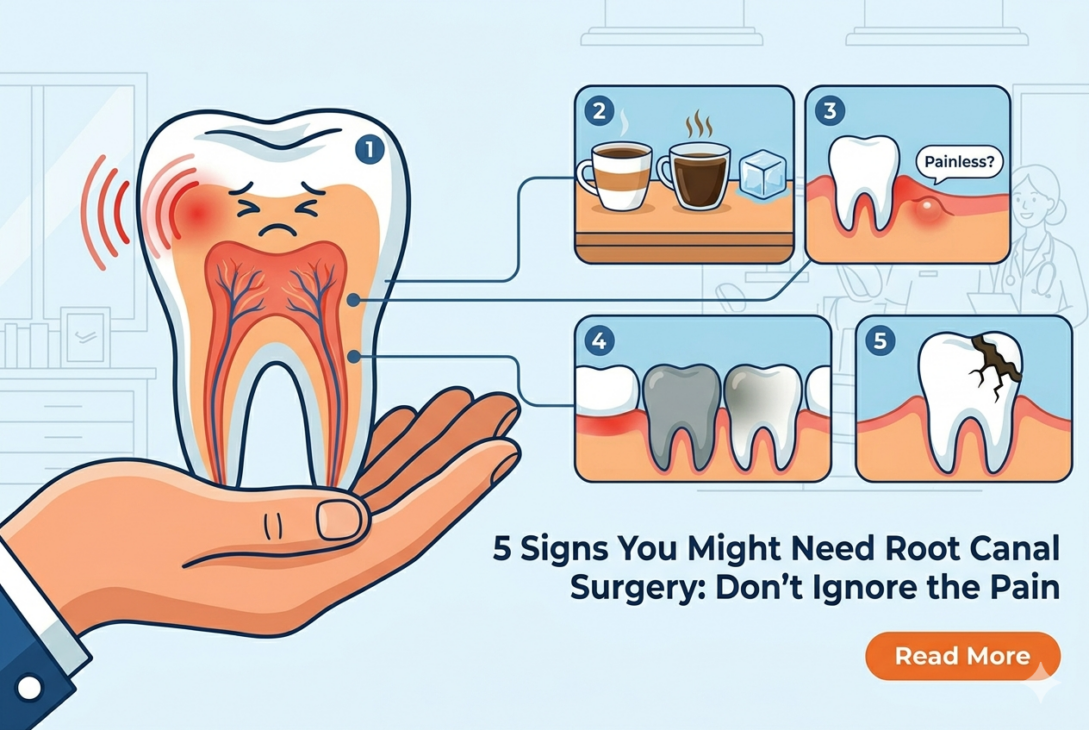
1. Persistent or Severe Tooth Pain That Won’t Go Away
Toothaches are not all created equal. An ache that comes on mildly and varies in intensity could be due to sensitivity or mild irritation. However, when the pain becomes deep-seated, thumping, or persistent, it will often be a warning sign.
Discomfort of this nature can sometimes indicate inflammation or infection of the tooth’s pulp (the soft inner tissue containing nerves and blood vessels). The pain may also radiate to your jaw, ear, or neck (especially during chewing or pressure).
What really defines this kind of pain is its durability. If the pain provides only temporary relief (or sometimes none at all), this is a big red flag that the nerve may be damaged. Pretend the side of the road isn’t there until October 2023, and get to a point where you can’t ignore it. It will only get worse.
2. Sensitivity to Hot and Cold that Lingers
A sharp pinpoint of sensitivity when sipping something hot or cold is something we have all experienced, which you might forget, but not for more than a few seconds. That’s normal. However, what is not normal is pain that persists long after the temperature stimulus is gone.
If you sip a coffee or a cold drink and the discomfort lingers for a few seconds—or minutes—that is a signal that the nerve inside the tooth is being threatened. That lingering period of sensitivity generally suggests that your pulp is either inflamed or infected.
The difficult thing about it is you might not recognize how bad it truly is. This may begin as mild discomfort, but can worsen with time. However, once the nerve is affected, it seldom heals on its own. Getting to it early and addressing it can save you from more invasive treatment down the road.
3. Painful or Tender gums around a tooth
Inflammation in your gums is never normal, especially not localised to a single tooth. You may also find a sore, bump or an actual pimple on your gum.
This lump, commonly called a fistula, is how your body passes infection through the tooth. It may wax and wane, seeming less serious than it really is. However, lurking just below the skin, the infection remains.
Without antibiotics, this can lead to more severe complications, such as bone involvement or the spread of the infection. The root cause of the problem is infected tissue, which is removed, and the nerve is killed.
4. A Darkened or Discolored Tooth
A tooth that suddenly appears darker than the surrounding teeth is more than a cosmetic problem; this is often evidence of some type of internal damage. The tooth may be dark in color, gray, or dull in appearance when the pulp inside the tooth dies or becomes infected.
Such discoloration may also develop following trauma (for example, an injury) or as an outcome of chronic decay. It is tricky because it does not always come with pain. The tooth no longer feels healthy, but you may not feel anything at all.
That’s why visual changes matter. A darkened tooth should always be checked out, regardless of whether it hurts. Addressing it early will return both functionality and aesthetics and prevent further sequelae.
5. Sensitive Tooth Decay, Cracking, and Chipping
An injury to the outer structure of a tooth can allow bacteria to access the inner pulp. A small crack or chip can lead to a big issue if left untreated.
You may have felt sharp pain when you bite down or chew. This occurs when the pressure reveals the damaged nerve of the tooth. Bacteria can become more ingrained over time, causing infection and pain to linger longer than they should.
In those situations, the goal is to save the tooth. During a root canal, the dentist can clean out the infected tissue and seal the area to prevent it from getting worse. A crown is usually placed afterwards to strengthen and protect the tooth over the long term.
The Importance of Early Treatment in Saving Your Tooth
Here is the truth: dental problems do not go away on their own. The mild discomfort intensifies into excruciating pain as it starts flowing out of control, leading to the loss of a tooth.
The positive aspect is that new root canal treatments focus on efficiency and comfort. They aim to eliminate the infection, relieve pain, and preserve your natural tooth. Acting sooner not only reduces the chance of discomfort and the need to manage it, but also (in many cases) increases the likelihood of a successful outcome.
FAQs
Is a root canal painful?
Modern procedures are surprisingly comfortable, often no worse than a standard filling, much to the surprise of many.
How long does the process take?
This typically takes one or two visits, depending on how complicated the case is.
The question is: If the pain goes away, can I avoid a root canal?
Not necessarily. Pain goes away temporarily, but the problem can still be there.
What if I wait to start treatment?
If waiting, it can lead to worsening infection, increased pain, and loss of a tooth.
How am I meant to know that I actually need one?
The only way to accurately assess whether treatment is warranted is with a dental assessment with imaging.