
A captivating smile can completely transform your confidence, but the ultimate goal of cosmetic dentistry is a look that feels uniquely yours. No one wants a smile that enters the room before they do. A flawless smile makeover does not rely on a “one-size-fits-all” template. Instead, it balances artistic design with advanced dental science to enhance your face without looking artificial.
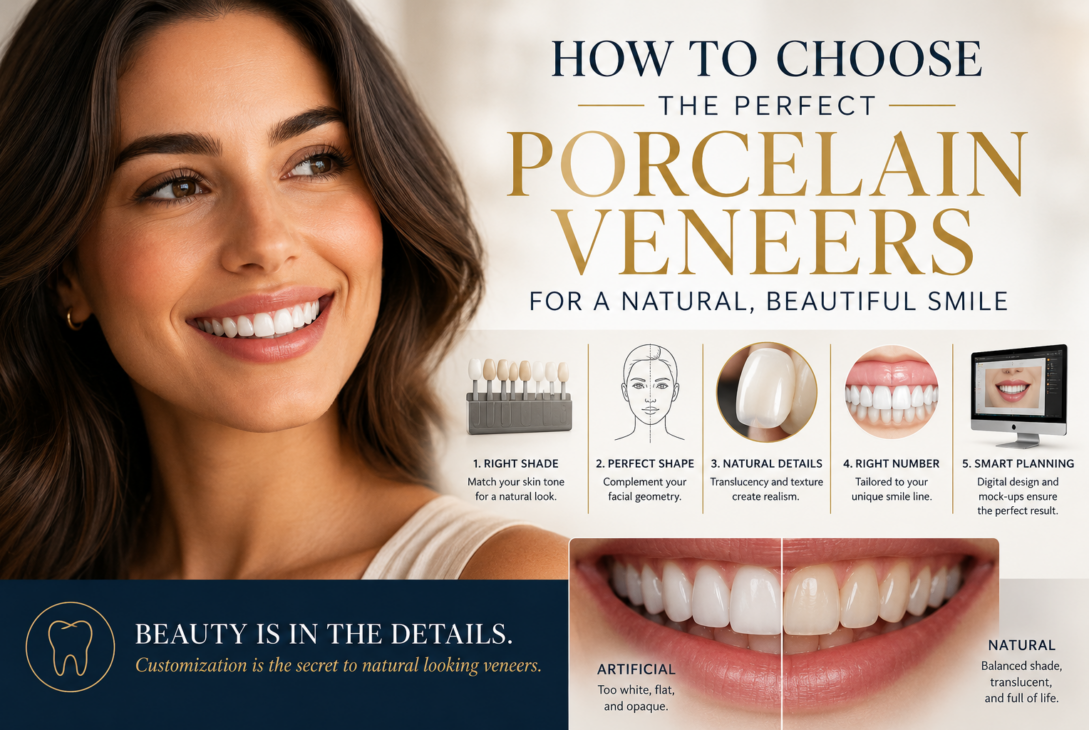
If you want to upgrade your teeth, the secret lies in customization. Achieving natural-looking veneers requires a careful evaluation of color, shape, translucency, and facial symmetry.
Here is a comprehensive guide to choosing the perfect porcelain veneers for a seamless, beautifully authentic result.
1. Select the Right Color Shade (Avoid the “Chalky” Look)
The most common mistake people make is picking the absolute whitest shade available. This choice often results in an opaque, chalky appearance that lacks dimension. Natural teeth possess depth, subtle warmth, and varying gradients of color.
The “Eye White” Rule
To keep your smile looking authentic, try to match the brightness of your veneers to the whites of your eyes. Choosing a shade that is significantly brighter than your sclera will instantly look artificial and draw negative attention.
Skin Tone Harmony
Your complexion plays a vital role in how your teeth look in real-world lighting.
-
Fair Skin: Can comfortably accommodate brighter, cooler porcelain shades without looking washed out.
-
Medium or Olive Skin: Blends best with natural, warm ivory hues that complement the golden undertones of your skin.
-
Dark Skin: Looks best with slightly warmer tones that provide a natural, soft contrast rather than a stark, jarring pop of white.
Understanding Shade Categories
Standard dental shade guides range from natural tones (like A1 or B1) to ultra-bright Hollywood bleached shades (BL1 to BL4). While B1 was traditionally considered the brightest natural tooth shade, bleached shades offer enhanced brightness. For a truly realistic finish that looks bright yet authentic, ask your dentist to lean toward B1 or a soft BL4.
2. Match Tooth Shape to Your Facial Geometry
The outline, corners, and length of your porcelain shells dictate the overall character of your smile. A skilled cosmetic dentist will design shapes that balance your natural facial structure rather than fighting against it.
| Face Shape | Recommended Veneer Shape | Aesthetic Goal |
| Round Face | Longer, rectangular veneers | Adds vertical definition and subtly slims the face. |
| Square Face | Slightly rounded or soft-square edges | Softens a strong, angular jawline and adds approachability. |
| Oval Face | Square or soft-square shapes | Adds subtle width and maintains ideal facial symmetry. |
| Heart Face | Shorter, rounded contours | Complements a delicate lower jaw and a pointed chin. |
By tailoring the incisal edges (the biting surfaces) to your face shape, your dentist can create a harmonious look. For example, rounded edges project a softer, more feminine aesthetic, while square edges offer a bold, masculine appearance. Learn more about customized smile designs through Innovative Dental Aesthetics, where individual facial proportions guide every treatment plan.
3. Insist on Natural Translucency and Micro-Texture
Real tooth enamel is not a solid block of opaque color; it is semi-translucent. Light penetrates the surface of the tooth and reflects out from the deeper dentin layer. This phenomenon is what gives natural teeth their life and vitality.
Edge Translucency
The incisal edges of your natural teeth often look slightly clear or even blue-gray. When ordering your fabrications, ensure your cosmetic dentist instructs the lab technician to build subtle, translucent layers into the edges of the porcelain.
Micro-Texture and Surface Anatomy
Real teeth are not perfectly smooth glass. They feature tiny horizontal ridges, grooved imperfections, and subtle vertical hairlines that catch the light. A completely flat, glass-smooth veneer reflects light like a mirror, giving away its artificial nature. Custom surface texturing scatters light organically, ensuring your natural-looking veneers blend in seamlessly with surrounding teeth.
4. Determine the Right Number of Veneers
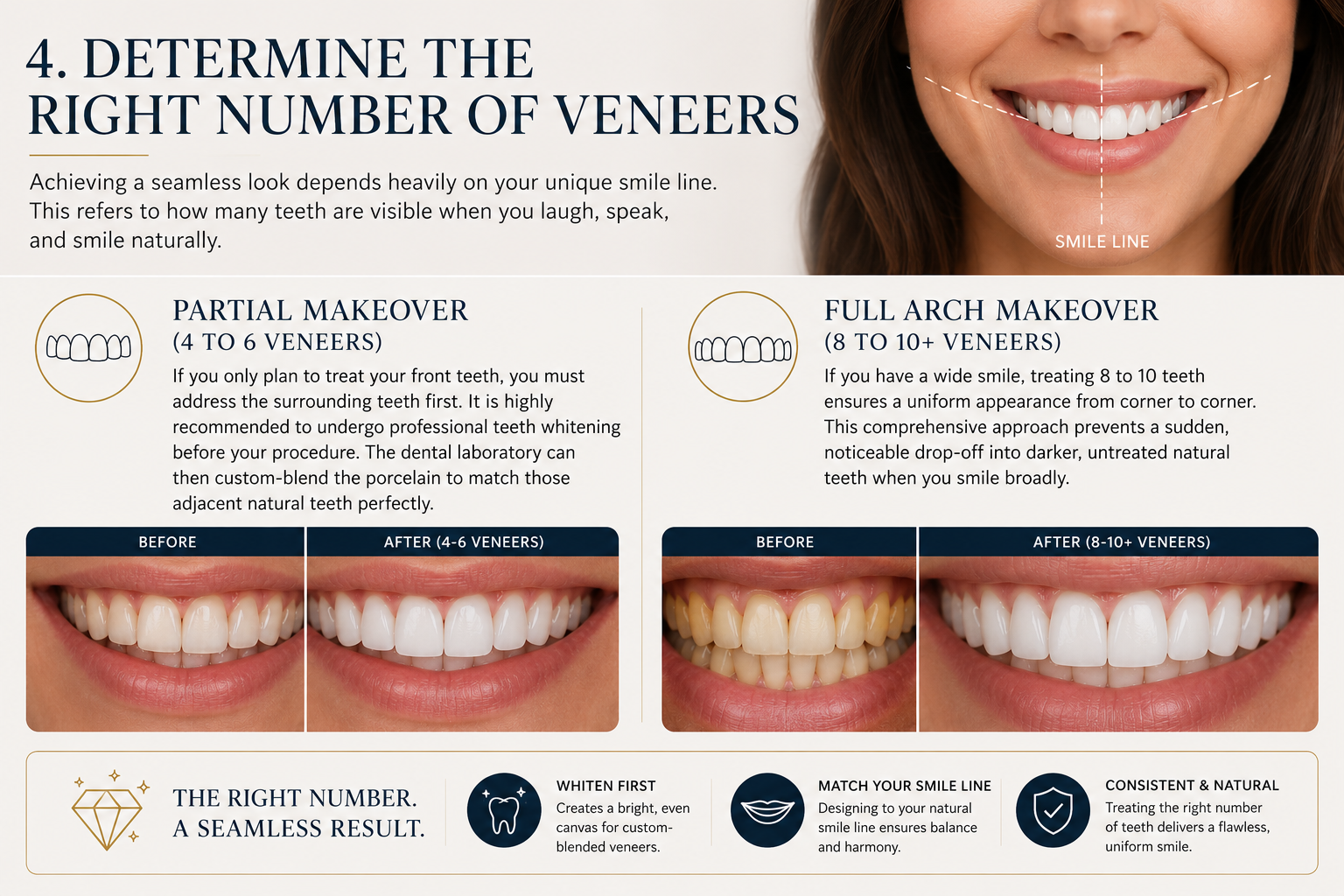
Achieving a seamless look depends heavily on your unique smile line. This refers to how many teeth are visible when you laugh, speak, and smile naturally.
Partial Makeover (4 to 6 Veneers)
If you only plan to treat your front teeth, you must address the surrounding teeth first. It is highly recommended to undergo professional teeth whitening before your procedure. The dental laboratory can then custom-blend the porcelain to match those adjacent natural teeth perfectly.
Full Arch Makeover (8 to 10+ Veneers)
If you have a wide smile, treating 8 to 10 teeth ensures a uniform appearance from corner to corner. This comprehensive approach prevents a sudden, noticeable drop-off into darker, untreated natural teeth when you smile broadly.
5. Prioritize the Preparation and Planning Phase
The final aesthetic result is only as good as the planning behind it. Modern cosmetic dentistry relies heavily on digital technology and physical trial runs to eliminate guesswork. According to authoritative clinical guidelines published by the American Academy of Cosmetic Dentistry (AACD), comprehensive diagnostic mock-ups are essential for achieving optimal, predictable outcomes.
Digital Smile Design (DSD)
Choose a cosmetic dentist who utilizes Digital Smile Design software. This technology allows the practitioner to simulate your future smile on a high-resolution photo of your actual face before any structural dental work begins. It bridges the gap between your expectations and the final product.
The Temporary Wax-Up Trial
Always test-drive your smile before the permanent porcelain is bonded. Your dentist will place temporary acrylic restorations based on the digital design. Use this crucial temporary phase to evaluate:
-
Length and Comfort: Ensure the teeth do not feel too long or interfere with your bite.
-
Phonetics: Practice speaking to ensure the shapes do not cause a lisp.
-
Lip Movement: Check how the teeth look during casual conversation and full laughter in real-world lighting.
Conclusion: Partner with the Right Expert
Investing in a smile makeover is a life-changing decision. While high-quality dental porcelain provides incredible durability, the artistry of your cosmetic dentist determines the final look. Achieving natural-looking veneers requires a professional who treats dentistry as both a science and a fine art.