
Most people visit their dentist for a standard cleaning and walk away feeling fresh. But what happens when the buildup goes deeper beyond what a routine polish can reach? If your dentist has mentioned gum disease, inflammation, or deep pockets, you may need more than a basic cleaning. You may need a deep teeth cleaning, also known as scaling and root planing.
This procedure targets the root of the problem literally. It removes hardened tartar and bacterial toxins from below the gum line, where a standard cleaning cannot go. Knowing the warning signs early can save your teeth and prevent irreversible bone loss.
According to the Centers for Disease Control and Prevention (CDC), nearly half of adults aged 30 and older in the United States have some form of periodontal (gum) disease. Many of them do not realize it until significant damage has already occurred.
What Is a Deep Teeth Cleaning?
A deep teeth cleaning is a clinical procedure performed by a dentist or dental hygienist to treat active gum disease. Unlike a regular prophylaxis cleaning, which polishes the surface of the teeth above the gum line, a deep cleaning goes beneath the gums to remove tartar and plaque from the tooth roots.
The procedure has two components:
- Scaling — The hygienist uses specialized instruments (or an ultrasonic device) to break up and remove hardened calculus from the tooth surfaces and below the gum line.
- Root Planing — The exposed root surfaces are then smoothed so that gum tissue can reattach more easily and bacteria have fewer places to cling.
Local anesthesia is typically used to keep you comfortable throughout the process. Depending on the severity of the disease, the procedure may be completed in one visit or across two appointments, treating one half of the mouth at a time.
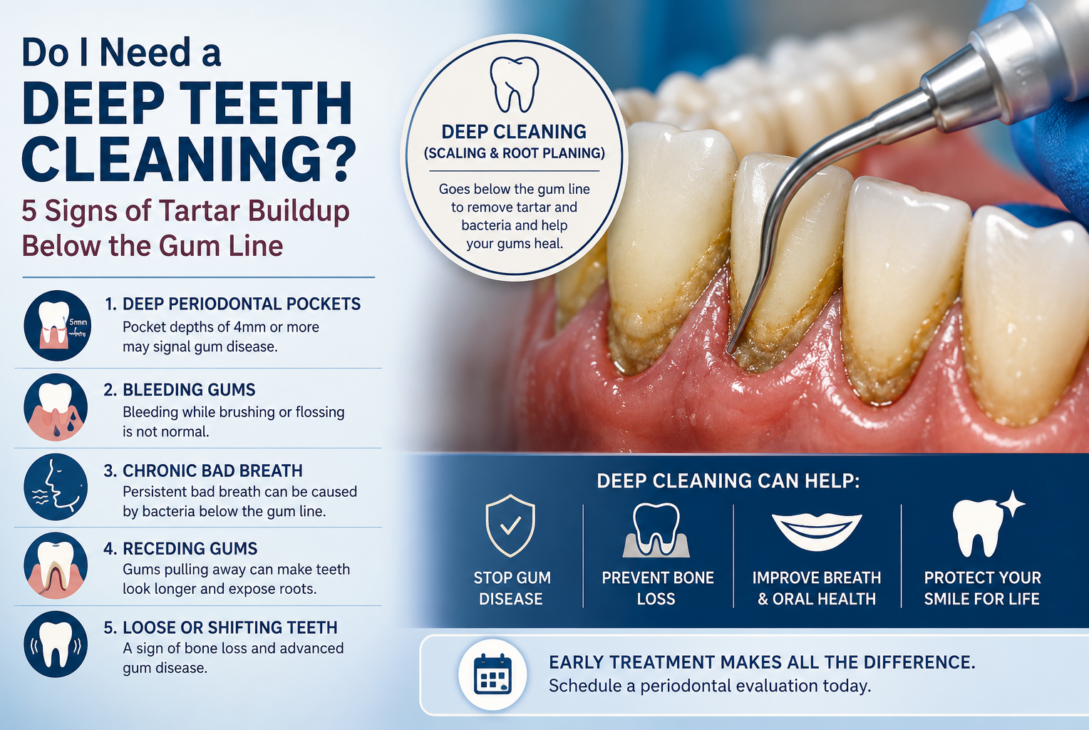
5 Signs You May Need a Deep Teeth Cleaning
Not everyone needs a deep cleaning, but certain warning signs indicate that tartar has already migrated below the gum line and active intervention is needed. Here are the five most important ones to watch for.
1. Deep Periodontal Pockets
During a routine dental exam, your hygienist uses a small probe to measure the spaces between your teeth and gums. This measurement is recorded in millimeters.
Healthy gum pockets typically measure between 1 and 3 millimeters. When pockets reach 4 millimeters or deeper, it signals that your gum tissue has begun to pull away from the teeth. These enlarged pockets create hidden spaces where bacteria and tartar accumulate freely, and where a standard cleaning brush simply cannot reach.
If your hygienist calls out numbers like 5, 6, or 7 during your exam, take note. Those measurements indicate the presence of active periodontitis that requires targeted treatment.
2. Gums That Bleed During Brushing or Flossing
Healthy gums do not bleed. If you consistently notice blood when you brush or floss, even gently, your gums are likely inflamed and infected.
Bleeding is your body’s immune response to a bacterial infection. Subgingival tartar (tartar below the gum line) harbors harmful bacteria that your immune system is constantly working to fight. The result is chronic inflammation, redness, puffiness, and bleeding that does not resolve on its own, no matter how diligently you brush.
Occasional bleeding from brushing too hard is normal. But recurring or spontaneous bleeding is always worth reporting to your dentist.
3. Chronic Bad Breath That Won’t Go Away
Persistent bad breath known clinically as halitosis is one of the most overlooked signs of subgingival tartar buildup. If you brush, floss, use mouthwash, and still notice a foul odor, the problem is likely not your tongue or diet.
The bacteria living in infected gum pockets produce volatile sulfur compounds (VSCs) as a byproduct of feeding on tissue and debris. These compounds have a distinct sulfur-like odor that originates deep beneath the gum surface. Because the source is below the gum line, surface-level oral hygiene does nothing to eliminate it.
If your breath issues feel stubborn and unexplained, schedule a periodontal evaluation rather than just reaching for more mints.
4. Receding Gums or Longer-Looking Teeth
Have you noticed that your teeth seem longer than they used to? Or that you can feel or see exposed root surfaces near the gum line? This is gum recession, and it is a significant warning sign.
As tartar accumulates below the gum line, it creates chronic irritation that pushes gum tissue away from the teeth. Over time, this recession exposes the sensitive root surfaces, which have no protective enamel coating. Exposed roots are not only more sensitive to hot and cold they are also more susceptible to further decay and infection.
Gum recession is largely irreversible without surgical intervention, which is why catching and treating the underlying tartar buildup early is critical.
5. Loose or Shifting Teeth
If your teeth feel wobbly, or if you have noticed a change in how your upper and lower teeth fit together when you bite, take this seriously. Loose teeth in adults are not a normal part of aging they are a symptom of advanced periodontal disease.
As tartar deposits and bacterial toxins erode the bone and connective tissue supporting your teeth, the foundation becomes unstable. Teeth begin to shift out of alignment, and in severe cases, they may need to be extracted if the disease is left untreated.
A deep teeth cleaning performed at this stage can halt the progression of bone loss, but the damage already done cannot typically be reversed without additional periodontal treatment.
Deep Cleaning vs. Regular Cleaning: What Is the Difference?
Many patients wonder why their dentist is recommending a different type of cleaning when they already come in for checkups. The distinction comes down to purpose and depth.
| Feature | Regular Cleaning (Prophylaxis) | Deep Cleaning (Scaling & Root Planing) |
| Primary Goal | Prevent gum disease | Treat active gum disease |
| Target Area | Tooth enamel above the gum line | Tooth roots below the gum line |
| Gum Status | Healthy gums (1–3mm pockets) | Infected gums (4mm+ pockets) |
| Bone Health | Bone structure is intact | Often accompanied by bone loss |
| Anesthesia | Generally not needed | Local anesthetic typically used |
| Frequency | Every 6 months for healthy patients | As needed; often followed by maintenance cleanings every 3–4 months |
What to Expect After the Procedure
It is normal to experience some sensitivity and mild soreness for a few days following your deep cleaning appointment. Your gums may be tender, and your teeth might feel more sensitive to temperature. Over-the-counter pain relievers and a soft food diet can help manage this discomfort.
Most importantly, your dentist will recommend a follow-up visit typically four to eight weeks after the procedure to measure your gum pockets again and assess how well your gums have healed and reattached to the tooth roots.
Following a deep cleaning, many patients are placed on a periodontal maintenance schedule of every three to four months rather than the standard six-month checkup. This more frequent schedule helps prevent the tartar from re-accumulating and keeps gum disease in check.
Can You Prevent the Need for a Deep Cleaning?
Yes, and prevention starts with consistency. The best way to avoid deep cleaning is to never let tartar build up below the gum line in the first place.
Here is what the evidence supports:
- Brush twice daily using a soft-bristled toothbrush and fluoride toothpaste.
- Floss at least once per day to disrupt plaque between the teeth and along the gum line.
- Visit your dentist every six months for a professional cleaning and exam.
- Avoid smoking or using tobacco products, as these dramatically increase your risk of periodontal disease.
- Manage systemic conditions like diabetes, which are closely linked to gum disease severity.
The American Academy of Periodontology recommends that patients with a history of gum disease maintain more frequent professional care to keep the condition from returning or worsening.
The Bottom Line
A deep teeth cleaning is not something to fear it is a targeted, effective treatment that can stop gum disease in its tracks and protect your smile for years to come. If you have noticed any of the warning signs discussed above bleeding gums, persistent bad breath, receding gum tissue, deep pockets, or shifting teeth do not wait for your next routine visit.
Schedule a comprehensive periodontal evaluation with your dental provider as soon as possible. The earlier gum disease is caught, the more options you have for conservative, comfortable treatment. Your gums and the teeth they support are worth it.